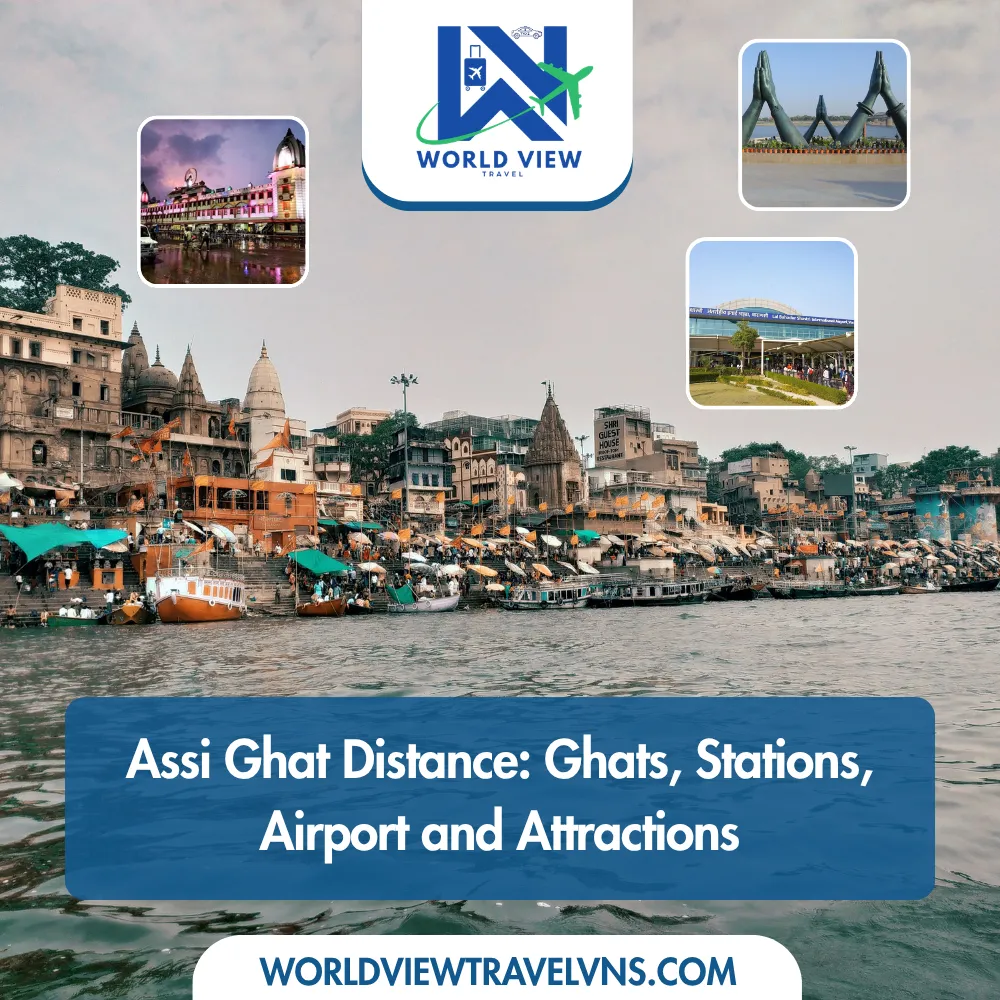

Assi Ghat is where the ghats of Varanasi begin, or end, depending on which way you are walking. It sits at the southern tip of the riverfront, and it is the one ghat that works from before dawn until late at night.
It is also the most relaxed of the major ghats. Wide open steps, room to sit, and a mix of pilgrims, students, foreign travellers and locals out for the evening. If Dashashwamedh is the spectacle, Assi ghat Varanasi is where you spend time.
This guide covers what it is, why it matters, what to do there, boat prices, safety and how it compares to the other ghats.
Assi Ghat, Varanasi
Assi Ghat is the southernmost of the main ghats in Varanasi, in the Shivala and Bhadaini area near Lanka and BHU. You will also see it written as Assi Ghat Banaras or Kashi Assi Ghat. Varanasi, Banaras and Kashi are the same city.
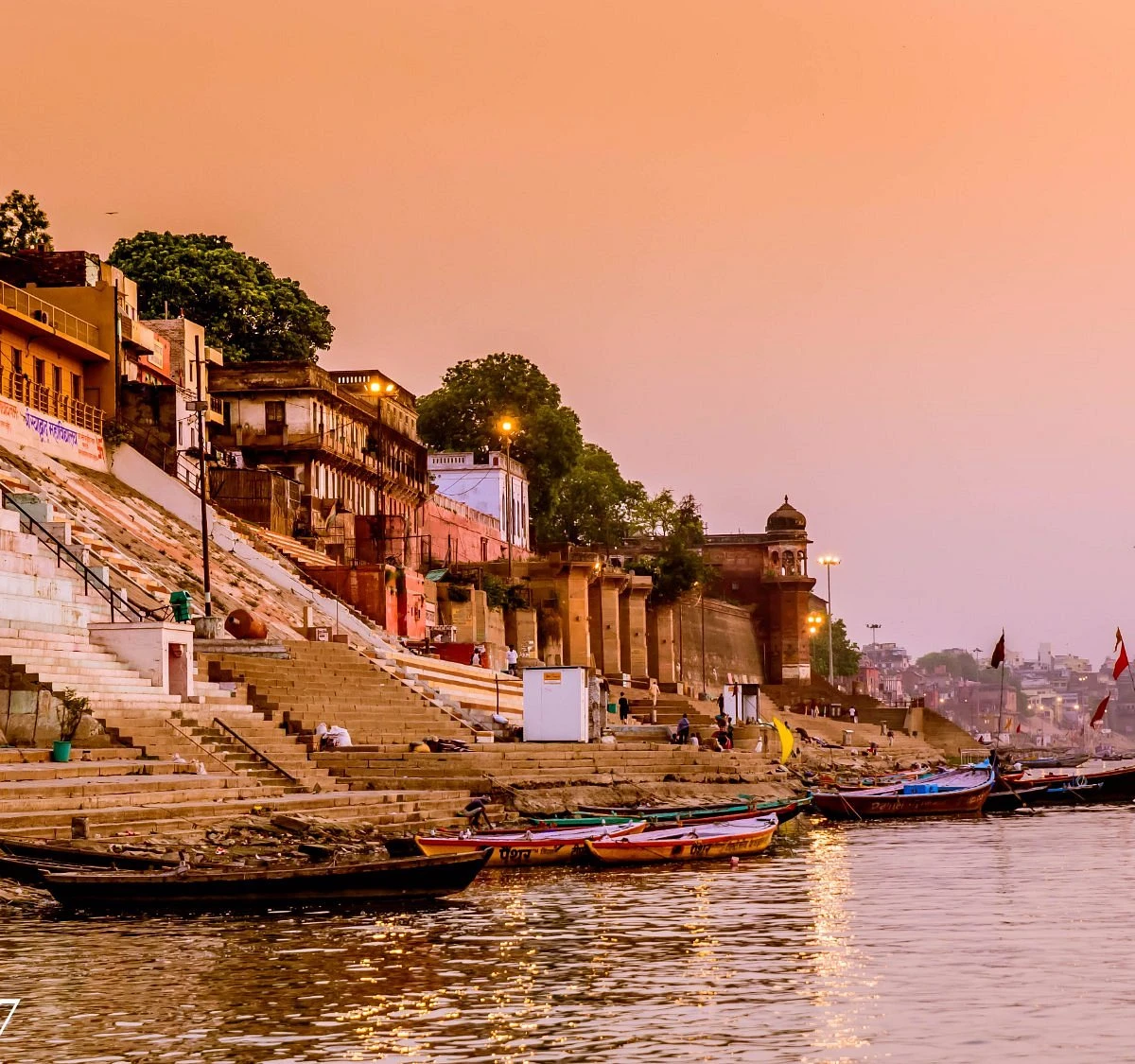
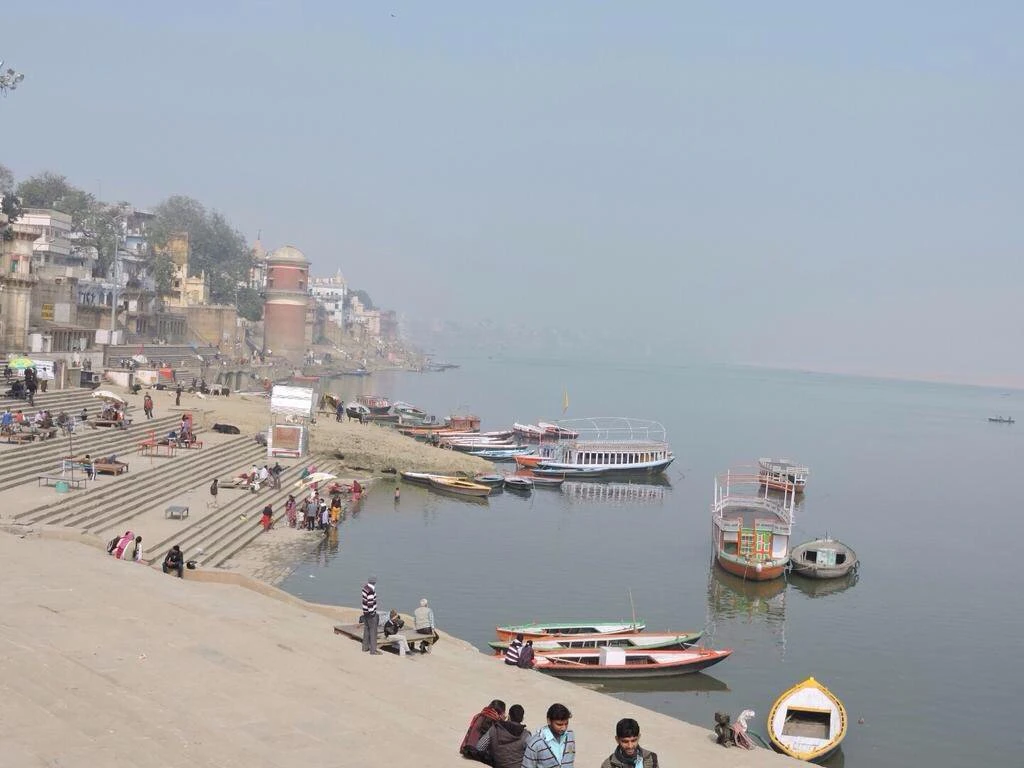
What makes it different from the others is space. Most ghats are narrow strips of steps hemmed in by buildings. Assi is broad and open, with a large platform, a peepal tree and room for a few hundred people to sit without being pressed together.
A normal day here runs like this. Before sunrise, the Subah-e-Banaras programme with chanting, aarti, classical music and yoga. Through the morning, pilgrims bathing and boats going out. Afternoons are quiet. From evening, the crowd builds again for the Ganga Aarti, and afterwards people stay on the steps for hours.
For a first visit, come at dawn. It is the hour that explains why people love this ghat.
Why Is Assi Ghat Famous?
Four reasons, and they pull in different kinds of visitors.
The confluence. Tradition holds that the Assi stream met the Ganga here, and a confluence of two rivers is sacred ground in Hindu practice. Bathing at a sangam carries particular merit.
Subah-e-Banaras. The daily dawn programme has become the ghat’s signature. Nothing else in the city offers chanting, live classical music, aarti and open-air yoga at sunrise, free, every day.
The atmosphere. Assi is where Varanasi is easiest to sit still in. Students from BHU, musicians, long-stay travellers, families. It has a neighbourhood quality that the busier ghats do not.
Position. It is at one end of the riverfront, so it is the natural starting point for a walk north along the ghats, and the easiest ghat to reach by road.
What Is the Religious Significance of Assi Ghat?
The ghat marks the southern boundary of the sacred area of Kashi. In traditional accounts, a pilgrimage of the city involves bathing at five ghats in sequence, the Panchtirthi, and Assi is the first of them.
Bathing here at the confluence is believed to cleanse sin, and pilgrims then worship at the Shiva shrine associated with the ghat. Kartik Purnima, Makar Sankranti and eclipse days draw very large numbers.
For devotees this is not a viewpoint. It is a place of practice, and the people around you at dawn are there to worship.
Why Does Assi Ghat Attract Foreign Tourists?
Practical reasons mostly. It is easy to reach by road, unlike the ghats deep in the lanes. There is space to sit. The cafés and guesthouses around it are used to foreign visitors. And the morning programme gives you a structured way into something that can otherwise feel impenetrable.
Longer-stay travellers often base themselves in the Assi area for exactly this. It is close enough to the old city to walk in, far enough out to sleep.
What Is the History of Assi Ghat?
Two threads, and they are worth keeping apart.
Tradition. The Assi appears in the Puranas and in accounts of Kashi’s sacred geography. The most-repeated story is that Goddess Durga threw down her sword after killing the demons Shumbha and Nishumbha, and where it struck the ground a stream burst out, becoming the Assi. That stream is said to have met the Ganga at this point.
Documented history. The ghat as a built structure is much more recent. Like most of the Varanasi riverfront, the stone steps date largely from the eighteenth and nineteenth centuries, when Maratha rulers, local kings and wealthy merchants funded ghat construction along the river.
The area also has a strong literary association. Goswami Tulsidas lived and died at Tulsi Ghat, immediately north of Assi, and wrote much of the Ramcharitmanas there. In modern times the neighbourhood is the setting for Shri Kashinath Singh’s novel Kashi Ka Assi, later filmed as Mohalla Assi.
The Assi stream itself is now largely a drain rather than a river, a change most articles about the ghat leave out. The confluence is still marked and worshipped, but what meets the Ganga today is not the stream of the old accounts.
Why Is It Called Assi Ghat?
From the Assi stream, which gave its name to the whole neighbourhood.
Where the name of the stream comes from is less settled. Two explanations circulate:
- From the Durga story, where “asi” means sword in Sanskrit, and the stream is said to have appeared where the goddess’s sword fell.
- From “assi” meaning eighty in Hindi, linked to a tradition that the stream was the eightieth stream, or to counts of the ghats. This is the folk explanation and it is weaker than the first.
The sword etymology is the one most sources favour, since Asi is a Sanskrit word and the Durga account is the older tradition.
Which Temples and Shivalinga Are at Assi Ghat?
Assi is not a temple. It is a ghat with shrines on and around it, which is why searches for “Assi Ghat temple” bring back a confusing mix of answers.
What is traditionally associated with the ghat:
The Shivalinga under the peepal tree. A large lingam worshipped in the open on the ghat itself, at the point associated with the confluence. Pilgrims worship here after bathing. This is the shrine most visitors mean when they talk about the Assi Ghat temple.
Asisangameshwar Mahadev. The Shiva shrine linked to the sangam, in the lane just back from the riverfront.
Lolark Kund. A stepped tank a short walk from the ghat, associated with the sun and with a long tradition of couples seeking children. It is busiest during Lolark Chhath in late summer, when the queues are enormous.
Tulsi Ghat, immediately north, with the Tulsidas temple and the Akhara.
Ganga Aarti and Subah-e-Banaras at Assi Ghat
Assi has two ceremonies a day. The morning Subah-e-Banaras programme starts before sunrise with Vedic chanting, a fire ritual, the morning aarti, live classical music and open-air yoga. The evening Ganga Aarti is the lamp ceremony, performed by priests facing the river.
Both are free from the steps. The morning is the quieter and, for many people, the better one.
For timings by season, how early to arrive, where to sit and how long each lasts, see our Assi Ghat aarti time guide.
What Are the Best Things to Do at Assi Ghat?
Watch the sunrise. The single best thing here. The light comes up over the sandbanks on the far side and hits the ghats front-on.
Join the morning yoga. Free, open to anyone, part of Subah-e-Banaras. Bring something to sit on.
Take a boat out. Covered below.
Walk north along the ghats. From Assi you can walk the riverfront past Tulsi, Shivala, Kedar and Harishchandra towards Dashashwamedh. Roughly two kilometres, an hour with stops. Not possible when the river is high after monsoon.
Sit on the steps and do nothing. More people do this than any other activity here, and it is not a joke. Assi rewards sitting still.
Drink chai and watch. Stalls run all day along the top of the ghat.
Listen to music. Impromptu playing is common in the evenings, and formal programmes happen through the year.
Photograph the ghat. Covered below.
Combine it with the southern temples. Sankat Mochan Hanuman Temple, Durga Temple and Tulsi Manas Mandir are all within a couple of kilometres. Our Kashi Darshan cab package covers that route.
Can You Take a Boat Ride From Assi Ghat?
Yes, and it is the thing most visitors remember.
Three kinds of ride:
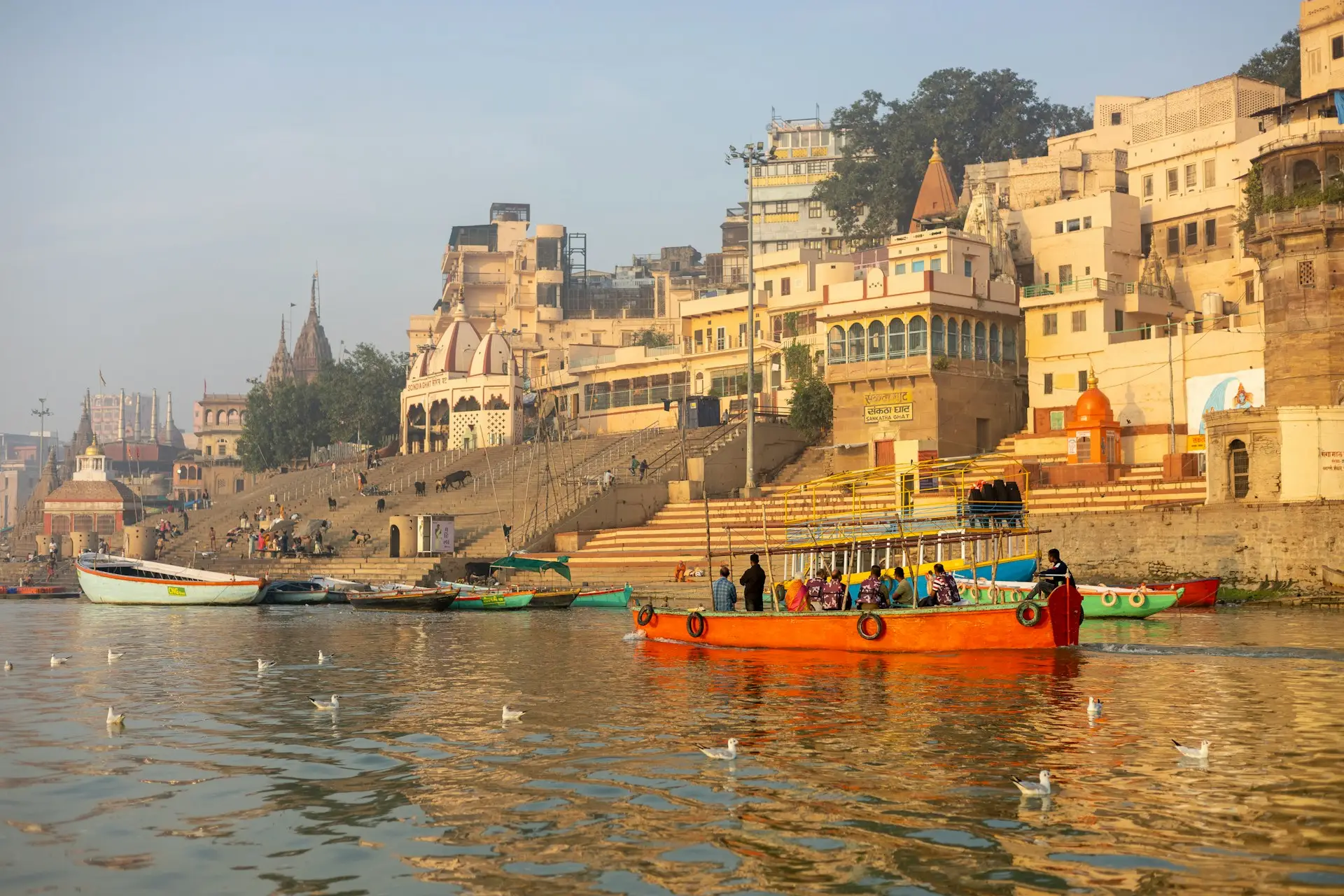
Sunrise ride. Out on the water as the light comes up, heading north past the ghats. The classic Varanasi boat trip and the one worth setting an alarm for.
Daytime sightseeing. Quieter, hotter, good for photographs of the ghats front-on.
Evening aarti ride. Out on the river during the Ganga Aarti, either at Assi or up at Dashashwamedh. Busiest, and the one to book ahead.
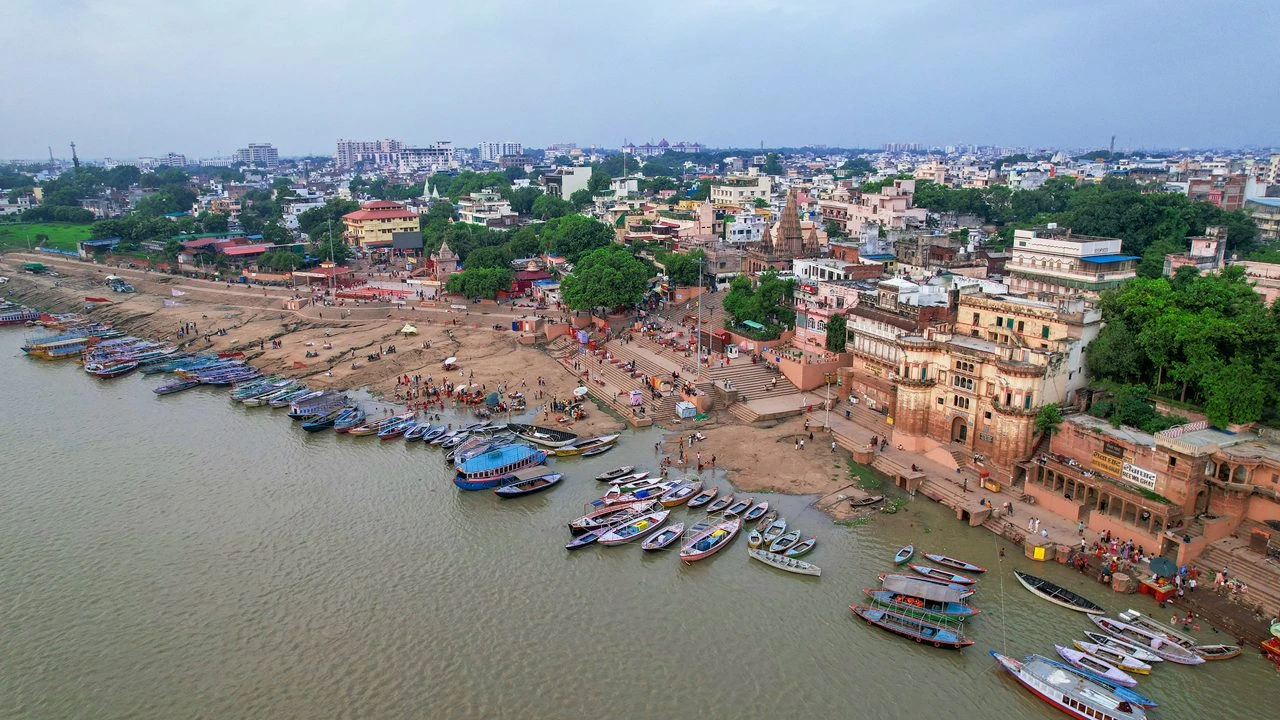
Most rides go north from Assi towards Dashashwamedh, passing the main ghats, and turn back. A longer ride can reach Manikarnika.
Rowing boat or motor boat. Rowing boats are quieter, slower and better for sunrise. Motor boats cover more river in the same time.
How Much Does an Assi Ghat Boat Ride Cost?
Shared boat: around ₹150 to ₹250 per person. Private boat: around ₹1,200 to ₹2,000.
Prices move with the season, the duration, the route and the day. Festival evenings cost considerably more, and around Dev Deepawali they bear no relation to a normal night. Our Dev Deepawali guide covers that separately.
Before you board, agree all of this:
- Total price, and whether it is per person or for the boat
- How long the ride lasts
- Which ghats you will pass and where you finish
- How many people will be on board if it is shared
Agree the number before you get in, not after. This is normal and expected, and it avoids the most common complaint visitors have about boats in Varanasi.
We arrange boats for our guests directly, with the price agreed in advance. Call or WhatsApp +91 78006 64900, or get in touch.
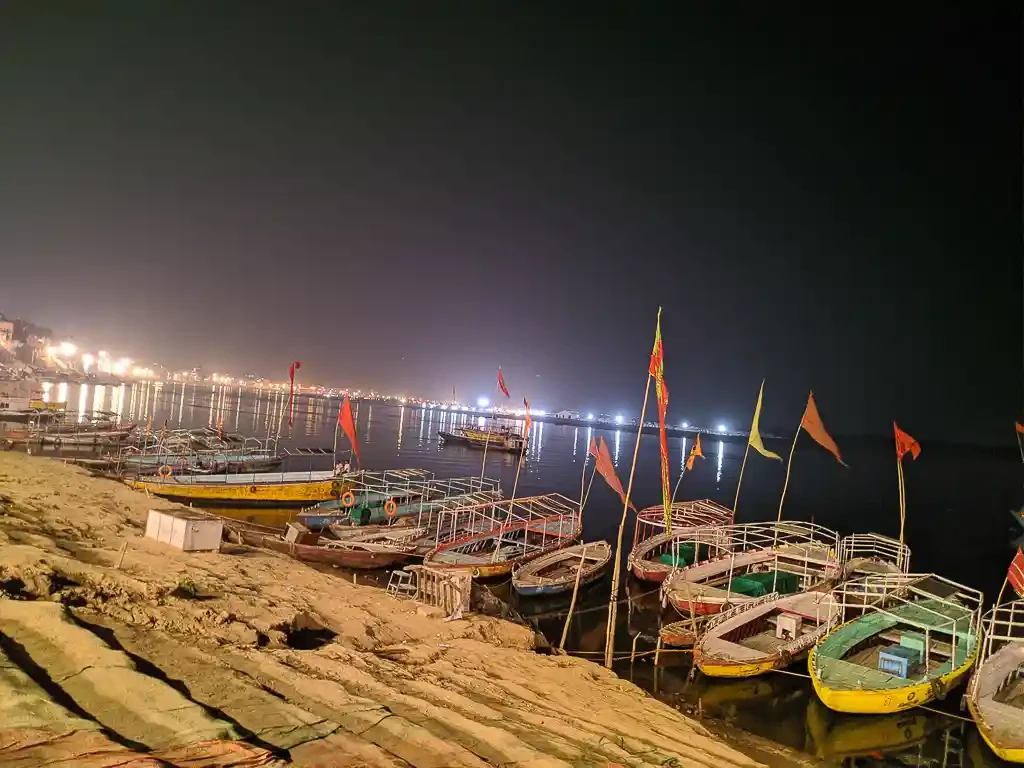
What Is Assi Ghat Like at Night?
Busier than you would expect, and pleasant.
After the evening aarti, most of the crowd stays. People sit on the steps talking, chai stalls stay open, and the cafés above the ghat fill up. The lighting is decent and the atmosphere is relaxed rather than edgy.
It stays lively until around 10 or 11 pm, then thins out. After that the steps get quiet and dark, and it is not the time to be wandering the lower ghats alone.
For a first-time visitor, the hour after aarti is one of the nicest times to be here. Late night is best left to people who know the area.
Where Is Assi Ghat and How Far Is It From Everything?
Southern Varanasi, in the Shivala area, PIN code 221005, near Lanka and BHU. It is the easiest major ghat to reach by road, since a main road runs to it and you are not walking through lanes.
Quick reference: Dashashwamedh about 3 km, Kashi Vishwanath about 3.5 km, Varanasi Junction about 6.5 km, the airport about 32 km, Sarnath about 14 km.
For full distances, travel times, routes and taxi fares, see our guide to Assi Ghat distances and how to reach it.
Which Places Can You Visit Near Assi Ghat?
Walking distance:
- Tulsi Ghat, immediately north, with the Tulsidas temple and the Akhara
- Lolark Kund, the stepped sun tank a few minutes back from the river
- Shivala Ghat and the ghats running north
Within two or three kilometres:
- Sankat Mochan Hanuman Temple
- Durga Temple and Durga Kund
- Tulsi Manas Mandir, next to Durga Temple
- BHU campus, with the New Vishwanath Temple and Bharat Kala Bhavan museum
Further, but easily combined:
- Dashashwamedh Ghat, Kashi Vishwanath and Manikarnika, north along the river
- Ramnagar Fort, across the river, about 8 to 9 km by road because of the bridge crossing
- Sarnath, about 14 km north
A good half day: dawn at Assi, then Sankat Mochan, Durga Temple and Tulsi Manas, back for breakfast. Our one day Varanasi itinerary covers a fuller version, and the Kashi Yatra with Sarnath tour does it as a package.
Assi Ghat or Dashashwamedh Ghat: Which Is Better?
They are not really competing.
| Assi Ghat | Dashashwamedh Ghat | |
|---|---|---|
| Evening aarti | Smaller, calmer, easy to get close | Large, elaborate, very crowded |
| Morning | Subah-e-Banaras, unique to Assi | Bathing and boats, no organised programme |
| Space | Wide and open | Tight, hemmed in |
| Access by road | Easy | You walk in from Godowlia |
| Best for | Sitting, sunrise, spending time | Seeing the big ceremony |
If you have one evening: Dashashwamedh, for the scale. If you have one morning: Assi, without question. If you have both: do exactly that.
Many visitors who see both end up preferring Assi, because you can actually experience it rather than being carried along by a crowd.
What Are the Timings of Assi Ghat?
The ghat itself is public and open at all hours. There are no gates and nothing to close.
The times that matter are the ceremonies, which follow sunrise and sunset and shift through the year. Full seasonal timings are in our aarti time guide.
Broad shape of the day: dawn until about 8 am is the best time to be here. Mid-morning is busy with bathers. Afternoons are hot and quiet. From about 5 pm the crowd builds for the evening.
October to March is the comfortable season. See our guide to the best time to visit Varanasi.
Is Assi Ghat Safe to Visit?
Generally yes, including for solo travellers and women, with normal precautions.
Assi is one of the better ghats in this respect. It is open, well used, and busy at the hours most visitors are there. Serious problems are rare.
What to actually watch for:
Unsolicited guides. People will approach offering to show you around or to perform a puja on your behalf. Some are genuine, many are not, and the price is rarely mentioned until afterwards. A polite no works.
Boat overcharging. The commonest complaint. Agree the total, the duration and the route before you board.
Wet steps. The lower steps are slick with river water and algae and people do fall. Watch your footing, especially in the dark.
The river edge. The Ganga has strong currents and the bed drops off quickly. Do not go deeper than knee height.
Crowds at festivals. Dev Deepawali, Kartik Purnima and eclipse days bring huge numbers. Keep your group together and agree a meeting point.
Late night. Fine until around 11 pm. After that, stay on the upper ghat and main roads.
What Should You Avoid at Assi Ghat?
- Do not walk through or across an aarti or a puja in progress
- Do not photograph people at worship or bathing without asking. A gesture towards your camera is enough to ask
- Never photograph cremations, at Assi or anywhere on the river
- Do not accept a service before the price is agreed, whether it is a boat, a guide or a puja
- Do not swim, and do not go past knee depth
- Do not leave bags unattended on the steps
- Do not leave litter. This is a sacred site, not a viewpoint
Can You Bathe at Assi Ghat?
Pilgrims bathe here every day, and for many people it is the reason they came. Bathing at the Assi confluence is one of the oldest practices associated with this ghat.
Whether you should is a different question, and it deserves an honest answer.
The water quality at Varanasi is poor. Fecal coliform readings in this stretch run far above the official safe limit for bathing. That is a documented fact and not in dispute.
Millions of people bathe in it anyway, most of them with a lifetime of exposure. A visitor without that exposure is in a different position.
If you want to take part in the ritual, this is what experienced travellers actually do:
- Stay in shallow water, ankle to waist deep, at the steps. Do not swim
- Keep your mouth closed and do not put your head under
- Do not go in with open cuts or grazes
- Rinse off with clean water and soap afterwards
- Go in the dry season, October to March, when the water is more settled. Avoid the weeks during and after monsoon
- Bring a change of clothes and a mat or bag for your things
- Women bathe in clothing, not swimwear. Follow what people around you are doing
If you would rather not go in, sprinkling water on your head, or touching it to your forehead, is an accepted form of the same act. Nobody will think less of you.
Speak to a doctor if you have any condition that affects your immune system.
Where Should You Eat Near Assi Ghat?
The Assi area has the best café concentration in Varanasi, along with proper Banarasi breakfast. Kachori sabzi and jalebi in the morning, chaat in the evening, lassi in clay cups, and rooftop cafés with river views for everything else.
Breakfast after the morning aarti is a ritual in itself for regulars here.
Our guides to the famous chaat of Varanasi and the best sweet shops cover where to go.
Where Should You Stay Near Assi Ghat?
The Assi neighbourhood has more choice than anywhere else on the riverfront: hostels, family guesthouses, boutique riverside hotels and a few larger properties nearby.
Staying here means walking to the dawn aarti instead of arranging a cab for 4:30 am, which is the main argument for it.
Things that decide the choice: river view or lane side, how far the walk to the steps is, road access for a taxi with luggage, and noise, since the ghat area is lively until late.
Which Festivals Take Place at Assi Ghat?
Dev Deepawali, on Kartik Purnima in November, is the biggest. Every ghat is lit with lamps and Assi is packed. See our Dev Deepawali guide.
Ganga Mahotsav, a cultural festival of music and dance held on the riverfront in the days before Dev Deepawali.
Kartik Purnima, the same date, with mass bathing from before dawn.
Makar Sankranti in January, another major bathing day, with kite flying across the city.
Lolark Chhath in late summer, centred on Lolark Kund just behind the ghat. Enormous queues.
Holi, which in Varanasi is intense. Assi is lively and messy. Go only if you want to be part of it.
Dates follow the Hindu calendar and move each year. Programmes for organised events change too, so confirm closer to the time.
What Is the Architecture of Assi Ghat Like?
Simpler than the ghats to the north, and that is what gives it its character.
Broad stone steps run down to the water in a wide, shallow sweep, rather than the steep narrow flights elsewhere. Behind them is an open platform with the peepal tree and the Shivalinga, and behind that the buildings of the Assi neighbourhood, low and unremarkable compared to the palaces further north.
The stepped design is functional. The Ganga rises many metres between the dry season and the monsoon, so the steps give access to the water at any level. In high water the lower steps disappear entirely and the ghat looks like a completely different place.
That absence of grand architecture is the point. Assi is a public space rather than a monument, which is why so much life happens on it.
Where Are the Best Photography Spots at Assi Ghat?
Sunrise from a boat. The ghats lit front-on with the sun behind you. The best photograph in Varanasi and the reason boats go out at dawn.
The steps at first light. Bathers, boats and the peepal tree, with mist on the water in winter.
From the top of the ghat looking down. Gives you the sweep of the steps and the river together.
The aarti, evening. Long exposure for the lamp movement. Go early for a front position and stay there.
A rooftop café. Elevation for wide riverfront shots without fighting the crowd.
Details. Chai glasses, marigolds, boats, feet on wet stone. The small things carry Varanasi better than the wide shots.
On respect: ask before photographing anyone at worship or bathing, never photograph cremations, and do not use flash during a ceremony.
Is There an Entry Fee for Assi Ghat?
No. The ghat is a public space, free to enter at any hour. The aarti and Subah-e-Banaras are free to watch from the steps.
You pay only for what you choose: a boat, a guide, a puja, food, or a rooftop table. Agree those prices before you commit.
Is Assi Ghat Worth Visiting?
Yes, and it is the ghat we send first-time visitors to.
It gives you the sacred side of Varanasi and the everyday side in the same place, without the crush of Dashashwamedh. You can sit for two hours. You can join the yoga. You can take a boat at dawn and walk to breakfast afterwards.
Best for: first-time visitors, families, older travellers, solo travellers, photographers, anyone who wants time rather than spectacle.
Be aware: the good hours are early, the steps are uneven, and festival days are extremely crowded.
If you have one morning in Varanasi, spend it here.
Frequently Asked Questions About Assi Ghat
What is Assi Ghat famous for?
The dawn Subah-e-Banaras programme, the evening Ganga Aarti, the traditional confluence of the Assi and the Ganga, and being the most open and relaxed of the major ghats.
Why is it called Assi Ghat?
From the Assi stream that traditionally met the Ganga here. The name is usually traced to “asi,” meaning sword, from the story of Durga’s sword falling at this spot.
What is the history of Assi Ghat?
The site appears in traditional accounts of Kashi’s sacred geography. The stone steps you see date largely from the eighteenth and nineteenth centuries, like most of the Varanasi riverfront.
Is there a temple at Assi Ghat?
Not a single temple. There is a large Shivalinga worshipped under the peepal tree on the ghat, the Asisangameshwar Shiva shrine nearby, and Lolark Kund a short walk away.
How much does a boat ride at Assi Ghat cost?
Around ₹150 to ₹250 per person on a shared boat, or ₹1,200 to ₹2,000 for a private one. Prices rise sharply on festival evenings. Agree the total before boarding.
Is Assi Ghat safe at night?
Yes until around 10 or 11 pm, when it is busy and well lit. After that, stay on the upper ghat and main roads.
Can you bathe at Assi Ghat?
Pilgrims do daily. Water quality is poor, so if you take part, stay shallow, keep your mouth closed, avoid it with open cuts and rinse off afterwards.
Is there an entry fee for Assi Ghat?
No. The ghat and both aartis are free. You pay only for boats, guides, pujas and food.
Which is better, Assi Ghat or Dashashwamedh Ghat?
Dashashwamedh for the large evening aarti. Assi for the morning, the space and the atmosphere. See both if you can.
How much time should I spend at Assi Ghat?
Two to three hours for a proper visit including the aarti. Longer if you take a boat or walk north along the ghats.