
Sankat Mochan Hanuman Temple is one of the three temples that locals in Varanasi will tell you to visit, along with Kashi Vishwanath and Durga Temple. It sits in the south of the city, near Lanka and BHU, and it is busy from before sunrise until late at night.
This guide covers what you need before you go. Timings, entry, the phone and camera rule that catches most first-time visitors, the history, the puja, and the festivals worth planning around.
We take guests here almost every week as part of our Varanasi temple runs, so the practical parts of this guide come from the gate, not from a listing site.
Sankat Mochan Hanuman Temple, Varanasi
Sankat Mochan Mandir is dedicated to Lord Hanuman. The name says what devotees come for. Sankat means trouble or crisis. Mochan means the one who removes it. So Sankat Mochan is Hanuman in his form as the remover of troubles.
You will see the temple written several ways online. Sankat Mochan Mandir Banaras, Sankat Mochan Mandir Kashi, Sankat Mochan Temple Varanasi. They all mean the same place. Varanasi, Banaras and Kashi are three names for the same city, and people use whichever one they grew up with.
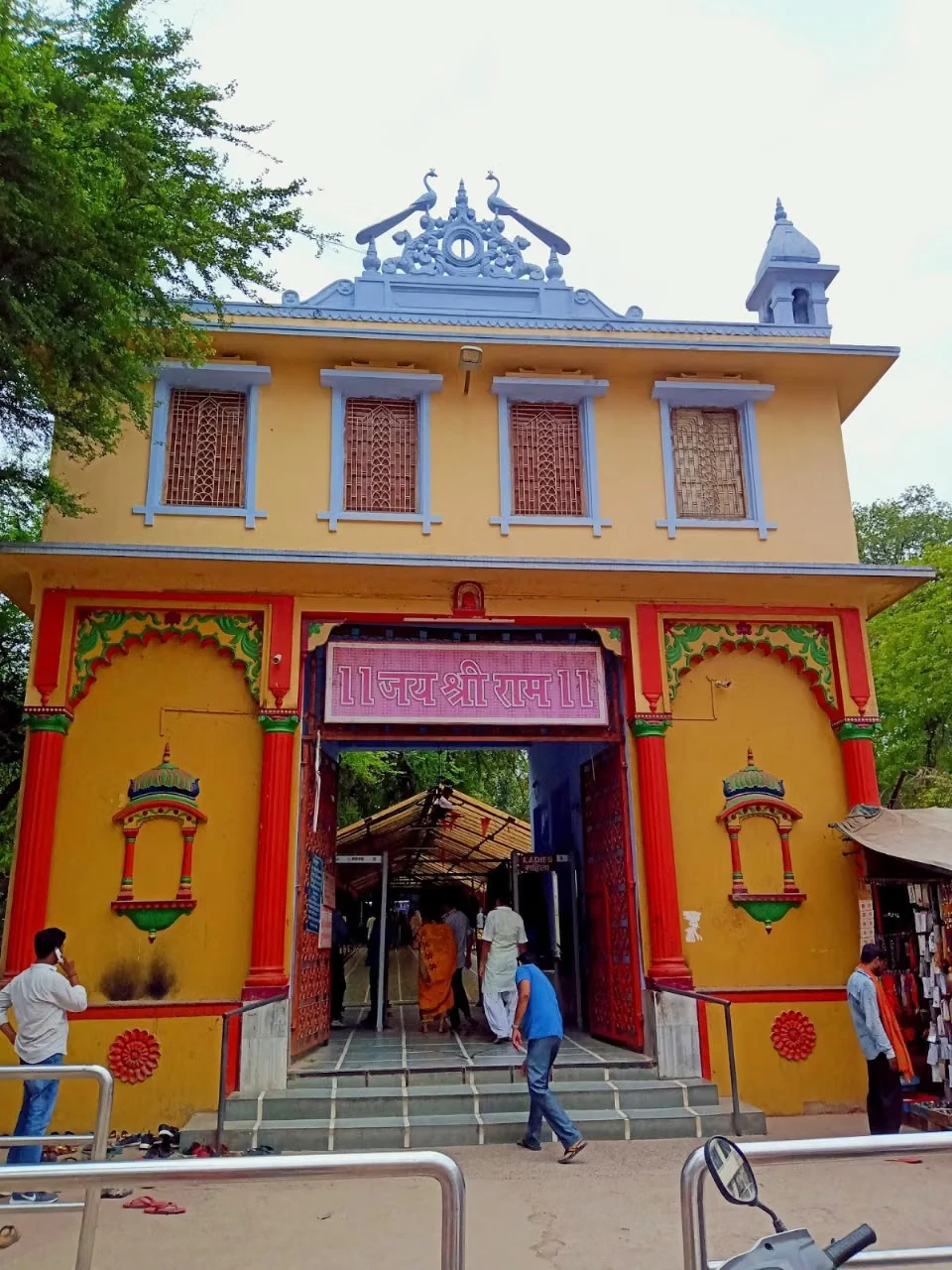
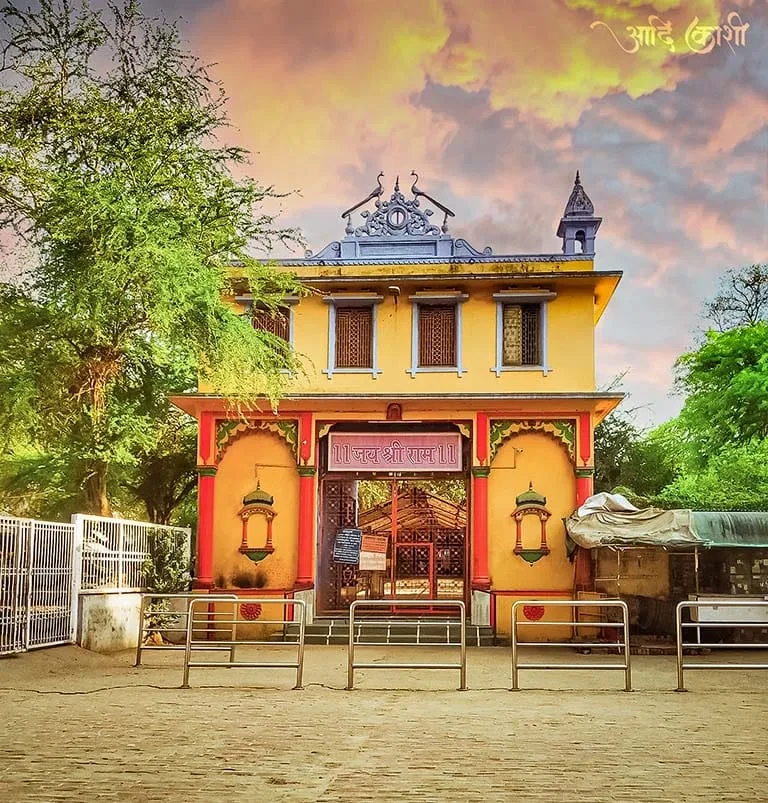
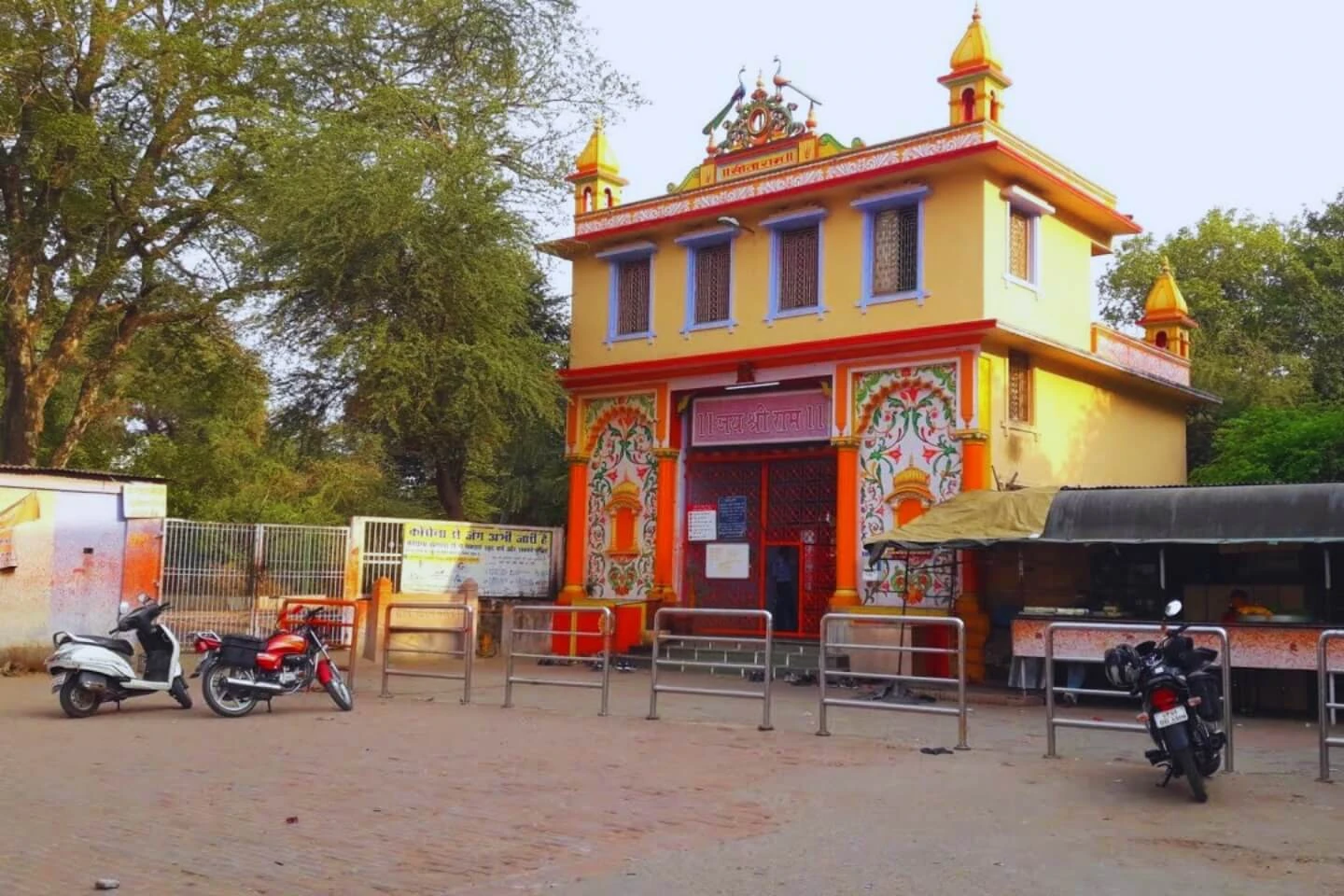
The temple is not grand in the way Kashi Vishwanath is. It is a low, open, red-and-white complex with a courtyard, a large tree and a steady stream of people. What people come for is the atmosphere. On most days there is chanting somewhere in the courtyard, and on Tuesdays and Saturdays the sound of the Hanuman Chalisa carries across the whole compound.
Which Deity Is Sankat Mochan Temple Dedicated To?
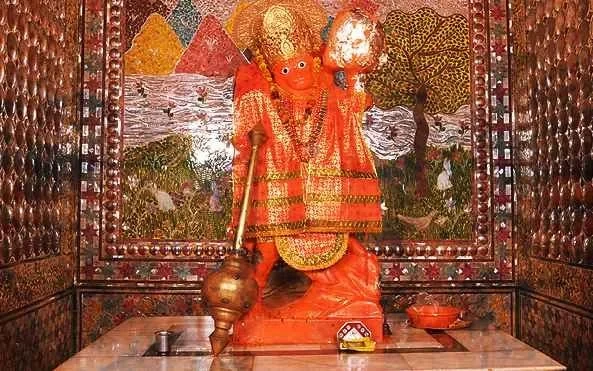
The temple is dedicated to Lord Hanuman. Devotees usually call him Sankat Mochan Hanuman Ji here.
The idol faces the shrine of Lord Rama, which matters to devotees. Hanuman’s devotion to Rama is the whole point of his story, and the placement here is meant to show him in that posture of service rather than as a deity being worshipped alone.
Varanasi has many Hanuman temples. This is the one that carries the most weight, partly because of its association with Goswami Tulsidas and partly because of its scale on Hanuman days.
What Should You Know Before Visiting Sankat Mochan Mandir?
A few practical things, because most guides skip them.
Phones and cameras are not allowed inside. This is the one that catches people. You deposit your phone at the counter near the gate before you go in. Photography inside the temple is not permitted. Plan for it, and do not expect to take pictures of the shrine.
There is a security check at the entrance. The temple has had permanent police presence since 2006. Bags are checked. How long it takes depends entirely on the crowd. On a quiet weekday morning you walk straight through. On a Tuesday evening the queue can be long.
Shoes come off before you enter. There are stands outside the gate where you leave them.
Dress simply. Covered shoulders and legs. This is an active place of worship, not a monument, and most people around you are there to pray.
Carry as little as possible. With phones deposited and bags checked, the less you have, the faster you get in.
Prasad and offering shops sit right outside the gate. Besan laddu is the traditional offering to Hanuman here, along with sindoor and flowers. Prices vary by shop and by day, so ask before you buy.
What Are The Timings Of Sankat Mochan Temple In Varanasi?
The temple is generally open from around 5:00 am to 10:00 pm, every day of the year. Aarti is performed in the early morning and again in the evening.
We want to be straight with you about this. Published timings for Sankat Mochan vary a lot between sources. Different sites list opening at 4:00, 4:30 or 5:00 am, closing anywhere between 9:00 pm and 10:30 pm, and some mention a midday break that others do not. The temple does not publish an official schedule online.
What is consistent:
- The temple is open every day, all year
- There is a morning aarti and an evening aarti
- Hours are extended on Tuesdays and Saturdays, and during festivals
- Timings change during Hanuman Jayanti and other major occasions
So if your visit depends on catching a specific aarti, confirm on the day rather than trusting any published table, including ours. Any driver or hotel desk in Lanka or Assi will know the current timing.
What Is the Entry Fee for Sankat Mochan Temple?
There is no entry fee. Darshan at Sankat Mochan Hanuman Temple is free for everyone, and there is no paid or VIP queue.
You will spend money only if you choose to. Prasad and offerings from the shops outside, and voluntary donations inside the temple. Neither is required to enter or to have darshan.
Where Is Sankat Mochan Hanuman Temple Located?
The temple is in Saket Nagar, in the Nagwa and Lanka area of south Varanasi, pin code 221005.
To place it: it is close to Banaras Hindu University, a short distance from Durga Temple and Tulsi Manas Temple, and roughly two kilometres from Assi Ghat. Most visitors combine it with those, because they sit in the same part of the city.
Autos, e-rickshaws and cabs all run here and every driver in Varanasi knows it by name. Traffic in the Lanka stretch gets slow in the evening and much worse on festival days, so leave more time than the distance suggests.
If you would rather not deal with autos, our Kashi Darshan cab package covers the main temples in one run, and our local sightseeing cab works if you want to build your own route.
For routes, distances and transport options from the station, the airport and Kashi Vishwanath, see our guide to the Sankat Mochan Varanasi address and how to reach it.
What Is the History of Sankat Mochan Hanuman Temple?
Two things are often mixed together here, so it is worth separating them.
The tradition. The temple is associated with Goswami Tulsidas, the poet-saint who wrote the Ramcharitmanas. The belief is that Tulsidas had a vision of Hanuman at this spot in the sixteenth century and founded a shrine here because of it. This is the account devotees hold, and it is the source of the temple’s standing.
The building. The temple as it stands today is much more recent. The present structure was built in the early twentieth century by Pandit Madan Mohan Malviya, the founder of Banaras Hindu University. Most articles about this temple mention only Tulsidas and leave this out, which is why visitors are sometimes surprised that the complex does not look five hundred years old.
Both things are true at once. The site and the devotion go back to Tulsidas. The buildings you walk through were built by Malviya. Holding those apart is the honest version of the temple’s history.
Its position in Kashi grew from that Tulsidas connection. Varanasi is a Shiva city, and Hanuman worship here has always drawn strength from the Ramcharitmanas tradition. Sankat Mochan became the centre of that.
What Is the Connection Between Tulsidas and Sankat Mochan Mandir?
Tulsidas lived in Varanasi and spent his later years at Tulsi Ghat, a short distance from here. He wrote the Ramcharitmanas, the Awadhi retelling of the Ramayana that shaped Hanuman devotion across north India. The Hanuman Chalisa is also attributed to him.
The traditional account is that he founded this shrine at the place of his vision. For devotees, that link is what makes Sankat Mochan different from any other Hanuman temple in the city. The Chalisa he wrote is recited here every day by thousands of people, which closes a circle that most visitors feel even if they do not know the history.
Why Is Sankat Mochan Mandir Spiritually Significant?
People come here for a specific reason, and the name explains it. Hanuman as Sankat Mochan is approached for relief from difficulty. Illness, court cases, exams, money trouble, family problems, fear. Devotees come with something on their mind.
This is also why the temple has a strong connection with astrology. In Vedic astrology, Hanuman is associated with protection from the effects of Saturn and Mars. People with a difficult Saturn placement in their chart are often told to visit a Hanuman temple, and in Varanasi that means this one.
The BHU connection matters too. The university is close by, and students come here before exams and results in large numbers. On a normal weekday afternoon a good part of the courtyard is students.
What Types of Puja Are Performed at the Temple?
Most worship here is straightforward and does not need arranging in advance.
Darshan and offering. You join the queue, have darshan, and offer besan laddu, sindoor or flowers bought outside.
Hanuman Chalisa recitation. The most common practice at this temple. People sit in the courtyard and recite, alone or in groups. On Tuesdays and Saturdays it is near continuous.
Sundarkand path. The section of the Ramcharitmanas dealing with Hanuman, recited by devotees and groups.
Aarti. Morning and evening, and the busiest and most atmospheric time to be here.
Mangal aarti and special pujas on Tuesdays, Saturdays and festival days.
If you want a specific puja performed in your name, ask at the temple office rather than agreeing to anything with someone who approaches you outside. That is standard advice at any major temple in Varanasi.
What Is the Significance of Manokamna at Sankat Mochan Mandir?
Manokamna means a wish or a heartfelt desire. Devotees come to Sankat Mochan with a manokamna, ask for Hanuman Ji’s help, and many return to offer thanks if things work out.
Practices vary by family and region. Some tie a thread, some recite the Chalisa a set number of times, some come back on a specific number of Tuesdays. These are matters of personal faith and there is no fixed rule.
We are describing what devotees believe and do, not making claims about outcomes.
When Is the Best Time to Visit Sankat Mochan Temple?
Best time of day: early morning. The courtyard is calm, the queue is short, and you get a proper darshan without being moved along. Evening aarti is the other good option, but it is far busier.
Days to avoid if you want quiet: Tuesday and Saturday. Both are Hanuman days and the temple fills up. If you want the experience rather than the calm, these are exactly the days to come. The energy on a Tuesday evening is the reason many people visit at all. Just do not expect a peaceful visit.
Best months: October to March. Varanasi is comfortable then. April to June is very hot, and standing barefoot on stone in the afternoon is genuinely unpleasant. If you must visit in summer, go at dawn.
If you are planning around the weather generally, our guide to the best time to visit Varanasi covers the whole year month by month.
How Is Hanuman Jayanti Celebrated at Sankat Mochan Temple?
Hanuman Jayanti is the biggest day of the year here. It falls in the Hindu month of Chaitra, which usually places it in March or April.
The temple is decorated, special pujas run through the day, and Hanuman Chalisa and Sundarkand recitation continue almost without a break. Prasad is distributed on a large scale. The crowd is many times a normal day.
If you are visiting for the festival rather than for a quiet darshan, come very early and expect long queues, restricted movement and altered arrangements at the gate. If you happen to be in Varanasi on that date and simply want to see the temple, consider going the day before or the day after instead.
The Sangeet Samaroh is held around the same period, which makes this the busiest and most interesting week of the year at Sankat Mochan.
What Is the Sankat Mochan Sangeet Samaroh?
The Sankat Mochan Sangeet Samaroh is an annual festival of Indian classical music and dance held in the temple grounds. It is one of the most respected classical music events in the country.
A few things make it unusual:
- It runs for around five to six nights, through the night until morning
- Entry is free
- Artists perform without a fee. Their performance is treated as an offering to Hanuman, and being invited is considered an honour
- It is held around Hanuman Jayanti, so the dates shift each year with the Hindu calendar
Over the decades it has featured many of the biggest names in Indian classical music. For a traveller, it is a rare chance to hear music of that standard in a temple courtyard, for free, sitting on the floor with everyone else.
Dates are announced by the temple closer to the event and change every year. Anything you find listed for a past year is not a guide to the next one.
Who Is the Mahant of Sankat Mochan Temple?
The temple is led by Mahant Prof. Vishwambhar Nath Mishra. He is also a professor of electronics engineering at IIT (BHU) Varanasi, which is an unusual combination and a well-known one in the city.
He heads the Sankat Mochan Foundation, established in 1982, which works on cleaning the Ganga and on heritage and community work in Varanasi. The foundation runs its own water quality laboratory and has published pollution data on the river for decades. It functions separately from the temple’s daily religious activity.
Who Was Prof. Veer Bhadra Mishra?
The previous Mahant, Prof. Veer Bhadra Mishra, founded the Sankat Mochan Foundation in 1982. He was a professor of hydraulic engineering and former head of civil engineering at IIT (BHU), and he spent his life campaigning for the Ganga.
He received the UNEP Global 500 Roll of Honour in 1992 and was named one of TIME magazine’s Heroes of the Planet in 1999 for that work. He died in 2013, and his son continues both roles.
The line is worth knowing because it explains something about the temple. Its leadership has, for two generations, held together religious authority and scientific work on the river.
What Happened at Sankat Mochan Temple in 2006?
On 7 March 2006, a bomb exploded at Sankat Mochan Hanuman Temple during evening aarti. It was a Tuesday, so the temple was full. Ten people were killed there and around forty injured. A second blast that evening struck Varanasi Cantonment railway station. Across the attacks, 28 people were killed and more than a hundred injured.
In 2022, after a long trial, a court convicted the man identified as the mastermind and sentenced him to death.
The temple reopened and continued. A permanent police post was established inside the complex, and the security checks at the gate today date from this. Visitors are checked, bags are inspected, and there is a police presence throughout.
We include this because it explains what you will experience at the entrance, and because it is part of the temple’s recent history. It is not something that affects a visit today beyond the checks.
Sankat Mochan Temple Photos
Frequently Asked Questions About Sankat Mochan Hanuman Temple Varanasi
What are the timings of Sankat Mochan Temple in Varanasi?
The temple is generally open from around 5:00 am to 10:00 pm daily, with aarti in the early morning and evening. Hours extend on Tuesdays, Saturdays and festivals. Published timings vary between sources, so confirm locally if you are planning around a specific aarti.
Where is Sankat Mochan Hanuman Temple located?
Saket Nagar, Nagwa, in the Lanka area of south Varanasi, pin code 221005. It is near BHU and about two kilometres from Assi Ghat.
Is there an entry fee at Sankat Mochan Temple?
No. Entry and darshan are free, and there is no paid queue.
Are phones and cameras allowed inside Sankat Mochan Temple?
No. Phones are deposited at the counter near the gate and photography inside is not permitted.
Which deity is Sankat Mochan Temple dedicated to?
Lord Hanuman, worshipped here as Sankat Mochan, the remover of troubles.
Who built Sankat Mochan Temple?
The shrine is traditionally associated with Goswami Tulsidas in the sixteenth century. The present temple structure was built in the early twentieth century by Pandit Madan Mohan Malviya, the founder of BHU.
Which days are busiest at Sankat Mochan Temple?
Tuesdays and Saturdays, which are dedicated to Hanuman, and Hanuman Jayanti. Visit on another weekday morning for a quieter darshan.
How long does a visit take?
Around 30 to 45 minutes on a normal day, including the security check and depositing your phone. Much longer on Tuesdays, Saturdays and festival days.
Can non-Hindus and foreign visitors enter?
Yes. The temple is open to all visitors. Dress modestly and follow the same rules on shoes, phones and photography as everyone else.
What should I offer at Sankat Mochan Temple?
Besan laddu is the traditional offering to Hanuman here, along with sindoor and flowers. Shops outside the gate sell all of it.